





Identity
Reinforced strengths and roles become anchors for how the leader understands self.


Trait-Based Leadership Strengthens Perception Under Pressure
executive-ready • certificate-backed • workforce aligned
Most Leadership Development Starts After Perception Has Already Narrowed
Traditional leadership training often begins at the behavior layer:
communication | management | team dynamics | execution.
Trait-Based Leadership begins one level deeper:
perception under pressure.
Before action, every leadership decision is filtered through internal traits, archetypes, emotional regulation, and identity.
When perception narrows, leadership becomes reactive.
When perception expands, clarity, creativity, and authentic influence become available.
This strengthens:
executive presence
emotional intelligence
decision confidence
culture leadership
team trust
workforce resilience
A Structured Leadership Development Pathway for Measurable Growth
Leadership Modules
Six Trait-Based module identity and leadership progression framework
Leadership Assessment
Trait + Hero Archetype leadership baseline clarity
Guided Reflection Tools
Leadership workbook, reflection prompts, blueprint exercises
Archetype Development
Recognize balanced and shadow leadership patterns
Capstone Blueprint
Required Leadership Integration Blueprint for real-world application
Certificate Issuance
Certificate awarded upon capstone completion
The model develops ten core leadership traits across three dimensions:
GRIT — drive, resilience, determination
GRACE — empathy, appreciation, motivation
BALANCE — self-awareness, emotional intelligence, authenticity, creativity
Balance serves as the foundation of leadership by expanding perception and enabling individuals to respond rather than react.
Built for Workforce, University, and Organizational Adoption
Onboarding - Leadership cohort setup, baseline assessments, and role-based segmentation
Certificate Pathway - Individual leadership advancement and workforce credentialing
Corporate Cohorts - Department, executive, and cross-functional team training
Dashboards + Outcomes - Track leadership confidence, perception flexibility, communication growth, and team impact over time
Designed to support workforce grants, university leadership institutes, employer retention initiatives, succession planning, executive growth pipelines.
Flexible Leadership Development Options
Schools and youth organizations can begin with digital classroom access or expand into district-wide licensing and reporting.
$495 per participant
six-module program
leadership book
workbook
assessments
pre/post leadership growth
capstone blueprint
certificate
Custom quote for:
employers
universities
workforce boards
nonprofit institutes
executive teams
Includes: cohort training, retreats, facilitator-led sessions, executive workshops, team leadership diagnostics
Strength Spark
Strength Spark reinforces daily leadership awareness between cohort sessions, executive meetings, coaching, and organizational touchpoints.
This creates a repeatable reflection rhythm that strengthens:
leadership presence | perception under pressure | team communication | self-regulation | authentic influence
Bring Trait-Based Leadership Into Your Organization
Equip your professionals, faculty, workforce participants, and leadership teams with a shared strengths-based framework that expands perception, strengthens decision-making, and builds authentic leadership capacity.
Start with one cohort, one executive team, one university pathway, or one workforce initiative—and scale what works.
Leadership rarely breaks down because people lack strategies. It shifts when identity feels threatened, perception narrows, and strengths begin operating without proportion. Trait-Based Leadership helps leaders recognize that moment, regulate what follows, and shape systems where strength can remain balanced.
Leadership breakdown rarely begins at behavior. It begins at interpretation.
Behavior is the visible layer. Identity, perception, and energy shape what happens before the room ever sees a response.
A question lands differently. Feedback feels heavier. Certainty hardens before evidence is complete. The leader may still look composed while the internal field has already narrowed.
A reinforced strength becomes something the leader feels compelled to defend.
Attention shifts toward threat, instability, criticism, or loss.
Urgency, control, accommodation, or expansion begins shaping the response.
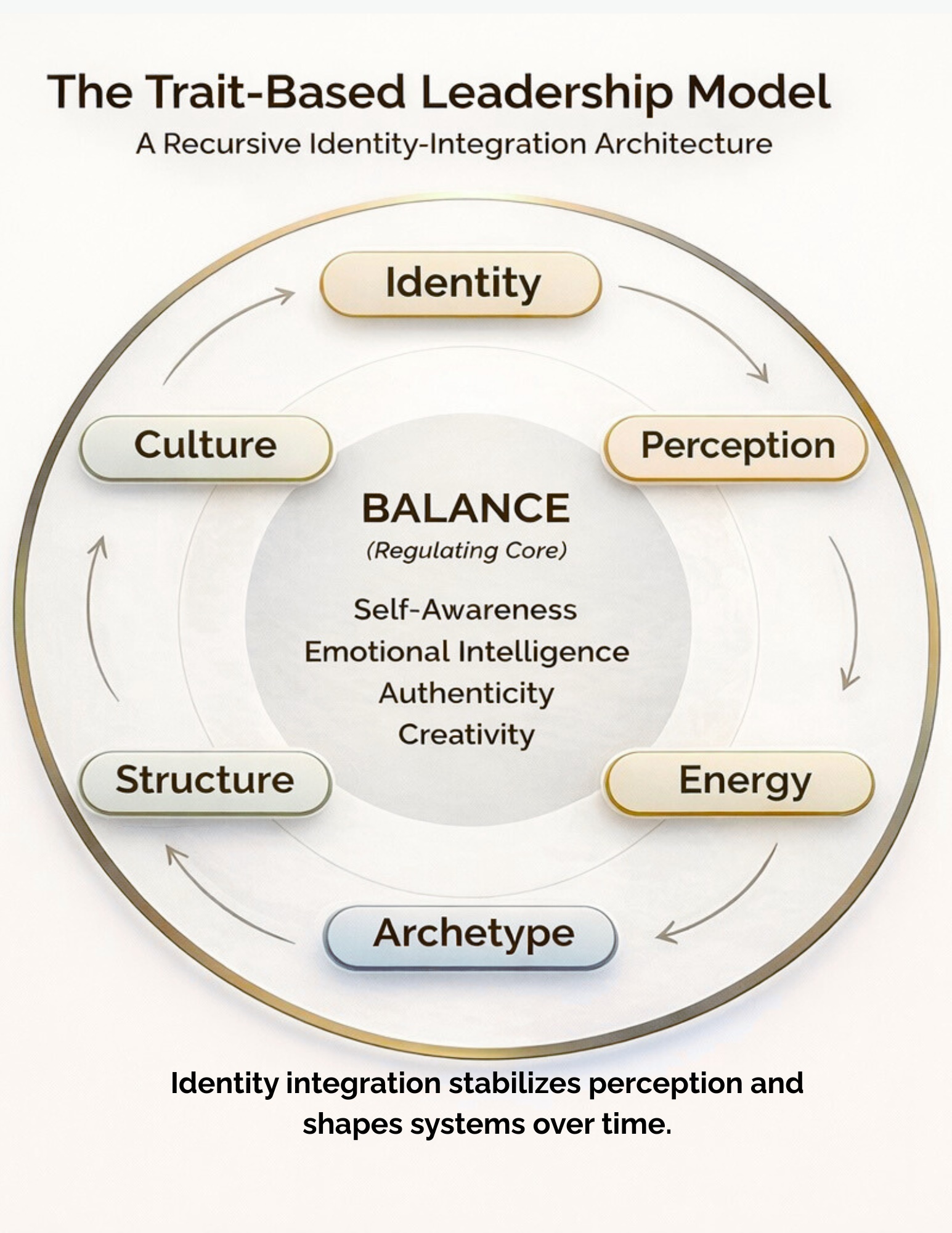
The model traces how internal posture becomes organizational reality. It is sequential enough to understand and recursive enough to reflect how leadership actually develops over time.
Reinforced strengths and roles become anchors for how the leader understands self.
Identity shapes what the leader notices, interprets, and assumes under pressure.
Narrowed perception increases physiological and emotional activation.
Energy organizes strengths into recognizable patterns of leadership posture.
Repeated posture becomes workflow, decision rhythm, authority, and expectation.
What the system repeatedly rewards and protects becomes normal over time.
Four developmental capacities help leaders shorten the distance between activation and regulation. They do not sit outside the model as another step sequence. They stabilize the full cycle.
Notice contraction, physiological cues, narrative formation, and the first signal that proportion is thinning.
Differentiate perceived threat from actual threat and understand what others may be experiencing.
Acknowledge pressure without collapsing, performing, or defending an identity that no longer serves the moment.
Reopen possibility beyond the default pattern and design a response with greater proportion.
Determination, tenacity, and resilience create movement and sustained effort.
Empathy, appreciation, and motivation create relational warmth and meaning.
The four capacities keep force and connection available without allowing either to distort.
Leaders are not placed into permanent types. Archetypes reveal how strengths tend to organize when the stakes rise, where shadow may appear, and what counterbalance can restore proportion.
Creates connection, psychological safety, belonging, and relational attunement.
Brings courage, advocacy, protective resolve, and the willingness to move toward difficulty.
Creates structure, clarity, responsibility, order, and reliable accountability.
Generates vision, imagination, influence, possibility, and energy for what could become real.
Leadership posture does not remain personal. It becomes meeting cadence, feedback flow, decision authority, conflict pathways, and restoration rhythm. Trait-Based Leadership helps leaders diagnose that structural echo and design systems that can hold balance even when pressure rises.

Perception Under Pressure and the Power to Activate Strength in Others provides the conceptual foundation for the model. It follows leadership from identity and interpretation through energy, archetype, systems, culture, conflict, burnout, and the institutionalization of balance.
When pressure changes perception, it changes decisions, relationships, and culture. These founder-led experiences help teams recognize what is happening beneath behavior, regulate energy, and activate strength in themselves and others.
A focused introduction to the model, its organizational relevance, and the connection between leadership perception, behavior, and culture.
A highly interactive experience focused on traits in balance and shadow, self-awareness, response under pressure, and a shared language for leadership.
A full-day experience integrating assessment, applied reflection, team dynamics, and a practical path for carrying the work into culture.
Founder-led leadership experiences begin at $4,500. Most half-day and full-day organizational engagements range from $7,500 to $12,500. Multi-day retreats and custom leadership initiatives are scoped individually. Travel is additional.
Organizational experiences are professional development engagements. They do not confer facilitator certification. The formal Trait-Based Leadership Certificate is available separately through Eastern Kentucky University.
The university credential provides a rigorous, accessible pathway through the full identity-integration architecture. Participants move sequentially through the book, applied reflection, assessment interpretation, system analysis, and a required Leadership Integration Blueprint.
This certificate taught me to pause and recognize when a trait was showing up in its balanced form or its shadow expression, first in myself and then in the people I lead. That awareness has changed how I make decisions, how I respond under pressure, and how I show up for my team.Morgan Albert, inaugural Trait-Based Leadership Certificate graduate, 2026
As the inaugural graduate, Morgan offers the first real voice from a new professional credential and an early view of what the work can make possible.
The EKU certificate is the current formal credential. The underlying model can also guide conversations about leadership development, organizational culture, and the systems that shape how people respond under pressure.
Move through the book, assessment, workbook, structured application, and Capstone through Eastern Kentucky University.
Explore how Trait-Based Leadership could support shared language, leadership reflection, cohort development, workshops, or a deeper look at culture and structural echo.
Learn to recognize the moment perception narrows, return strength to proportion, and build systems that help others lead and grow with greater clarity.